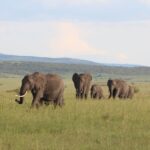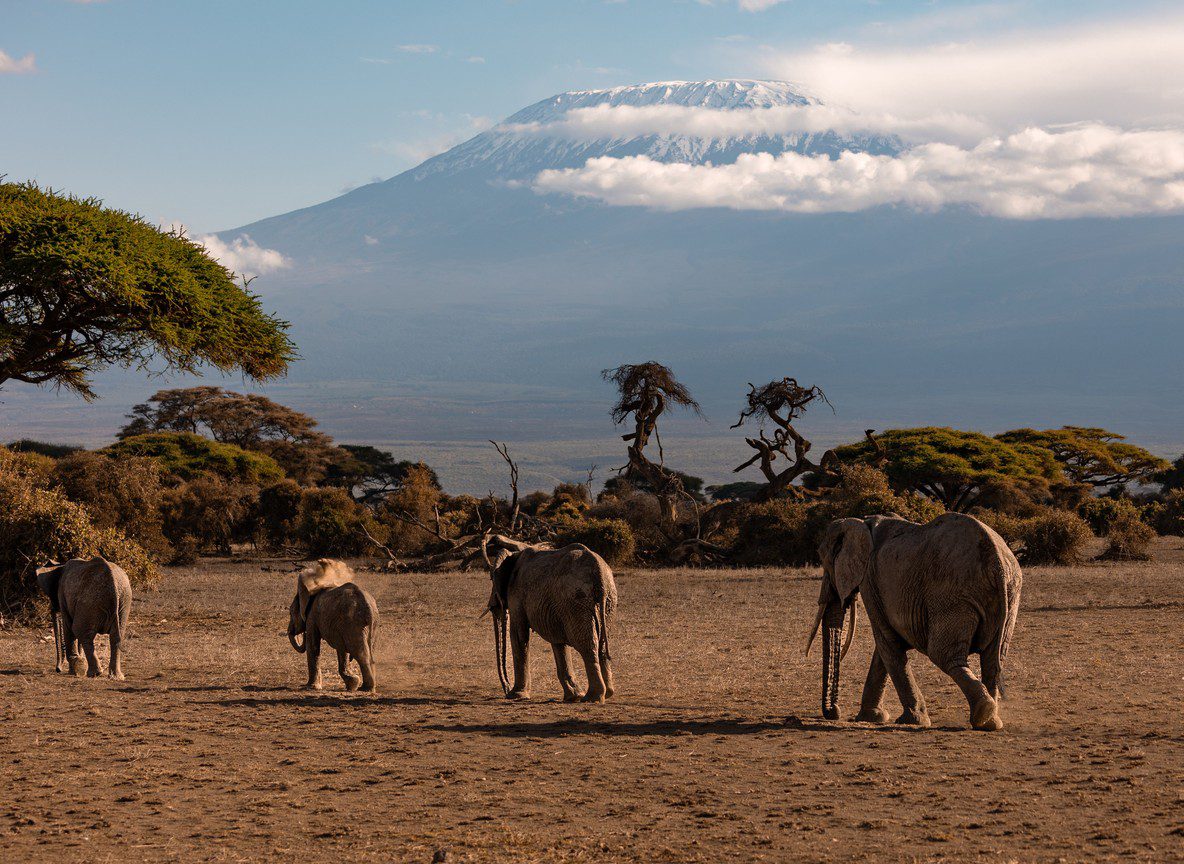
The elephants here do not look like elephants anywhere else on earth. They are stained deep terracotta from the iron-rich volcanic soil, and when a herd of forty moves across the Yatta Plateau in the afternoon light, the dust turns the sky amber and the ground carries the weight of it. This is Tsavo East National Park: Kenya’s largest park and one of the most underrated wildlife destinations in East Africa.
At 13,747 square kilometres of open semi-arid savannah, ancient lava flows, and permanent river, Tsavo East offers something most of Kenya’s famous parks cannot: raw, unmediated wilderness with far fewer vehicles at any given sighting. The park sits roughly 300 kilometres from Nairobi in southeastern Kenya, and it forms part of the greater Tsavo ecosystem alongside Tsavo West. The two parks have very different personalities.
This guide covers what makes Tsavo East worth choosing, what you will find there, when to visit, and how to reach it from Nairobi or the Kenyan coast.
What Sets Tsavo East Apart from Other Kenya Parks
Most visitors to Kenya head straight to the Masai Mara. That is understandable. But Tsavo East offers a quality the Mara cannot match: scale. Sightings here unfold across wide panoramas rather than through dense vegetation. You can watch a lion pride from half a kilometre away and follow the full hunt without losing sight of a single animal.
The red elephants are the park’s signature. They roll in the volcanic soil as a natural sunscreen and insect repellent, which coats their skin in that unmistakable rust colour. Tsavo East holds approximately 12,000 elephants, one of the highest concentrations in Kenya. These are also among the biggest-tusked elephants remaining in Africa, direct descendants of the legendary super-tuskers.
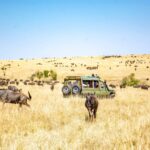
Tsavo East is flat and open compared to most Kenyan parks. That openness works in a visitor’s favour: predator hunts, elephant movements, and bird activity are all easier to observe across open ground than through thick bush.
The Galana River and Aruba Dam: The Ecosystem’s Heartbeat
Water is the organising principle of Tsavo East’s wildlife, and two landmarks define where the animals concentrate.
The Galana River runs east to west across the northern section of the park. It is the only permanent water source in the area and draws an extraordinary range of wildlife throughout the year. Hippos line the banks in groups of twenty or more. Crocodiles anchor themselves on sandbars in the midday heat. Elephants arrive in late afternoon to drink and bathe, often in herds stretching along the riverbank for hundreds of metres.
Aruba Dam, in the south, was built in 1952 and sits on the Voi River. It functions as a magnet for wildlife from the surrounding plains. Dawn game drives here are among the most productive in the park. During the dry season, herds of buffalo, zebra, and waterbuck arrive in the thousands. Lions, leopards, and cheetahs all use the dam as a hunting ground.
| Feature | Location | Peak Wildlife Activity |
|---|---|---|
| Galana River | Northern section | Year-round; peak dry season (July to October) |
| Aruba Dam | Central-south | Dry season (June to October) |
| Yatta Plateau | Western escarpment | Year-round game drives |
| Mudanda Rock | Central | Dry season elephant aggregations |
| Lugard Falls | Galana River (west) | Year-round scenery and crocodiles |
What You Will See: Key Attractions in Tsavo East
The red elephants are always the centrepiece, but Tsavo East’s wildlife extends well beyond them.
Big Five coverage Tsavo East holds lion, leopard, elephant, buffalo, and rhino. Lions here have a notable characteristic: the males are often maneless, a genetic trait specific to the Tsavo population that became internationally known after the man-eating lions of 1898. Two lions, working together over about nine months, killed and ate railway workers building the Uganda Railway bridge over the Tsavo River, halting construction until Lieutenant-Colonel John Henry Patterson finally hunted and killed both. The death toll is still argued over; the railway company’s contemporary records put it at 28, Patterson’s own later account claimed 135, and modern isotope analysis of the lions’ bones suggests a figure closer to 35. The story went on to inspire the 1996 film “The Ghost and the Darkness.” The rhino population is recovering at the Ngulia Rhino Sanctuary in Tsavo West, making combined itineraries worthwhile for anyone wanting comprehensive coverage of both parks.
Bird life Over 500 species have been recorded across the park. The Galana River floodplain is particularly productive, with Goliath herons, African fish eagles, and carmine bee-eaters nesting in the riverbanks during the right season. The park sits on major migratory routes, making the green season an excellent time for birding.
Lugard Falls The Galana River narrows through a series of ancient rock formations and carved channels, creating dramatic rapids. The water has polished the rock into smooth, sculpted forms over thousands of years. This is one of the most photogenic spots in the park and worth positioning for in the late afternoon light.
Mudanda Rock A 1.6-kilometre inselberg rising above the surrounding plains with a natural waterhole at its base. During the dry season, elephant aggregations here can be hard to believe until you see them firsthand.
Yatta Plateau At 290 kilometres, the world’s longest lava flow. It forms the western edge of Tsavo East and is geologically unlike anything else in East Africa.
The Elephants of Tsavo East: A Closer Look
The elephants of Tsavo East deserve their own section because they are genuinely unlike populations you encounter elsewhere in Kenya.
These are African bush elephants (Loxodonta africana), but the Tsavo population has traits shaped by their environment and history. The red soil coating is the most visible difference, but there is more. Tsavo East elephants tend to be large-bodied with long tusks. The genetic lineage here was less affected by the ivory poaching of the 1970s and 1980s than populations in other parks, which contributed to the survival of super-tusker genetics.
The park is also one of the best places in Kenya to observe natural elephant social behaviour at scale. Herds can number 50 to 200 animals. You will see matriarchs making movement decisions, juveniles play-fighting at the river, and bulls in musth patrolling the perimeters of family groups. Researchers from the Amboseli Elephant Research Project have documented Tsavo East as holding one of the most genetically diverse elephant populations remaining in East Africa.
No other Kenyan park combines this volume of animals, this tusk size, and this level of open-terrain visibility for elephant watching.
When to Visit Tsavo East
Dry season (June to October) is the peak game-viewing period. Vegetation thins, animals concentrate around permanent water, and the red dust is at its most photogenic in the golden hour. This is also the best time for large predator sightings because prey animals gather predictably at the Galana River and Aruba Dam.
Short rains (November to December) bring brief afternoon showers that green the park dramatically. Game viewing remains good, prices drop, and visitor numbers thin out considerably.
Long rains (March to May) make some roads challenging, but the park transforms into a genuinely lush landscape. This is the period for serious birding and, for visitors comfortable with possible road closures, a completely different style of photography.
January to February is a dry shoulder period with excellent game viewing and moderate visitor numbers.
For most first-time visitors, July through September offers the most reliable combination of wildlife concentration, dry roads, and dramatic light.
Getting to Tsavo East
From Nairobi by road Voi Gate, the main entrance, sits 335 kilometres from Nairobi on the A109 Mombasa highway. The drive takes approximately four hours in a 4WD vehicle. The road is well-maintained and straightforward.
By air Daily scheduled flights operate from Wilson Airport in Nairobi to Voi airstrip and Sala Gate airstrip inside the park. Flight time is approximately 45 minutes. Fly-in packages eliminate the road transfer and deliver you directly into the park with a full day available on arrival.
From the coast Tsavo East is Kenya’s most accessible major park from the coast. Voi Gate is 150 kilometres from Mombasa, roughly a three-hour drive. For visitors based at Diani Beach, Watamu, or Malindi, a two-day Tsavo East safari is one of the most practical and rewarding additions to a coastal trip.
Camps and Lodges in Tsavo East
The choice of camp matters in a park this size. The right location means a 10-minute drive to the Galana River or the Aruba Dam area rather than a 90-minute transit.
Classic experience: Satao Camp and Ashnil Aruba Lodge sit inside the park and offer direct wildlife access from camp. Both have full-board packages with guided game drives.
Luxury: Finch Hattons Luxury Tented Camp on the Galana River is considered one of the finest safari camps in Kenya. It operates on a fully inclusive basis with a private guide and vehicle.
Budget-friendly: Ndololo Safari Camp and KWS bandas near Voi Gate serve visitors who want quality park access at lower price points.
When choosing a camp, consider whether you want to focus on the Galana River corridor in the north, the Aruba Dam zone in the central-south, or a mixed programme. A single-camp stay of three nights works well for most first-time Tsavo East visitors.
Park Fees and Practical Information
Kenya Wildlife Service (KWS) charges entry fees per person per day. As of 2026, the standard adult non-resident rate is USD 52 per day. Children aged 3 to 17 pay a reduced rate. East African residents and Kenyan citizens pay significantly lower rates in Kenyan Shillings.
Fees are paid online through the KWS eCitizen portal before arrival. Confirm current rates directly with KWS, as fees are subject to annual revision.
Self-drive is permitted with a 4WD vehicle, though most visitors find a guided tour significantly more productive for wildlife spotting. Guides identify animals at distances that self-drivers routinely miss.
Recommended stay: Two days covers Aruba Dam, the Galana River, and Mudanda Rock at a reasonable pace. Three days is the comfortable standard. Add a fourth day if combining with Tsavo West, where the landscape shifts dramatically to volcanic terrain, thick bush, and Mzima Springs.
Explorer Notes: Practical Planning for Tsavo East
- Tsavo East combines well with the Kenyan coast: Voi Gate is 150 kilometres from Mombasa and accessible as a two-day add-on to a beach stay.
- Combined Tsavo East and Tsavo West itineraries are logistically straightforward: the two parks share a boundary along the Nairobi-Mombasa highway.
- Morning game drives are more productive than afternoon drives during the dry season. Predators are active in the early hours; by midday, most large mammals rest in shade.
- The maneless lions of Tsavo are most reliably seen near the Galana River and around Aruba Dam. Their lack of a mane makes them harder to spot in long grass than lions elsewhere in Kenya.
- The park covers 13,747 square kilometres. A single two-day visit will not cover the whole park, nor should you try. Concentrate on the Galana corridor and Aruba zone for a focused, productive first visit.
Conclusion: Why Tsavo East Stands Apart
Tsavo East recalibrates your sense of scale. The red-dusted elephants, the slow pulse of the Galana River, the silence between sounds in 13,000 square kilometres of semi-arid wilderness: it is a different quality of experience from the more visited Kenyan parks, and deliberately so.
The park’s size and openness reward patience. The visitors who get the most from Tsavo East are those who slow down, stay at the waterhole a little longer, and let the landscape do what it does without rushing on to the next point of interest.
Reader Next Steps
The Tourinsights Kenya safari planning guide covers the full circuit of options for combining Tsavo East with other Kenya destinations. For visitors planning a first safari to Kenya’s southeast, the guide to the greater Tsavo ecosystem covers both parks and the practical differences between them.
Every trip described here can be tailored: dates, budget, camps, and pace built around you.
Get a Personalised SafariFurther reading
More safari planning resources
- Map of Tsavo from Valley Safaris
- Tsavo destination guide on FindMySafari
- Big Five safari collection on FindMySafari
- Best time to visit Kenya month-by-month map from Valley Safaris
Related guides: What to Wear in Tsavo East National Park for Safari.